
Fleet Tire and Service Management: Best Practices and Recommended Service Intervals
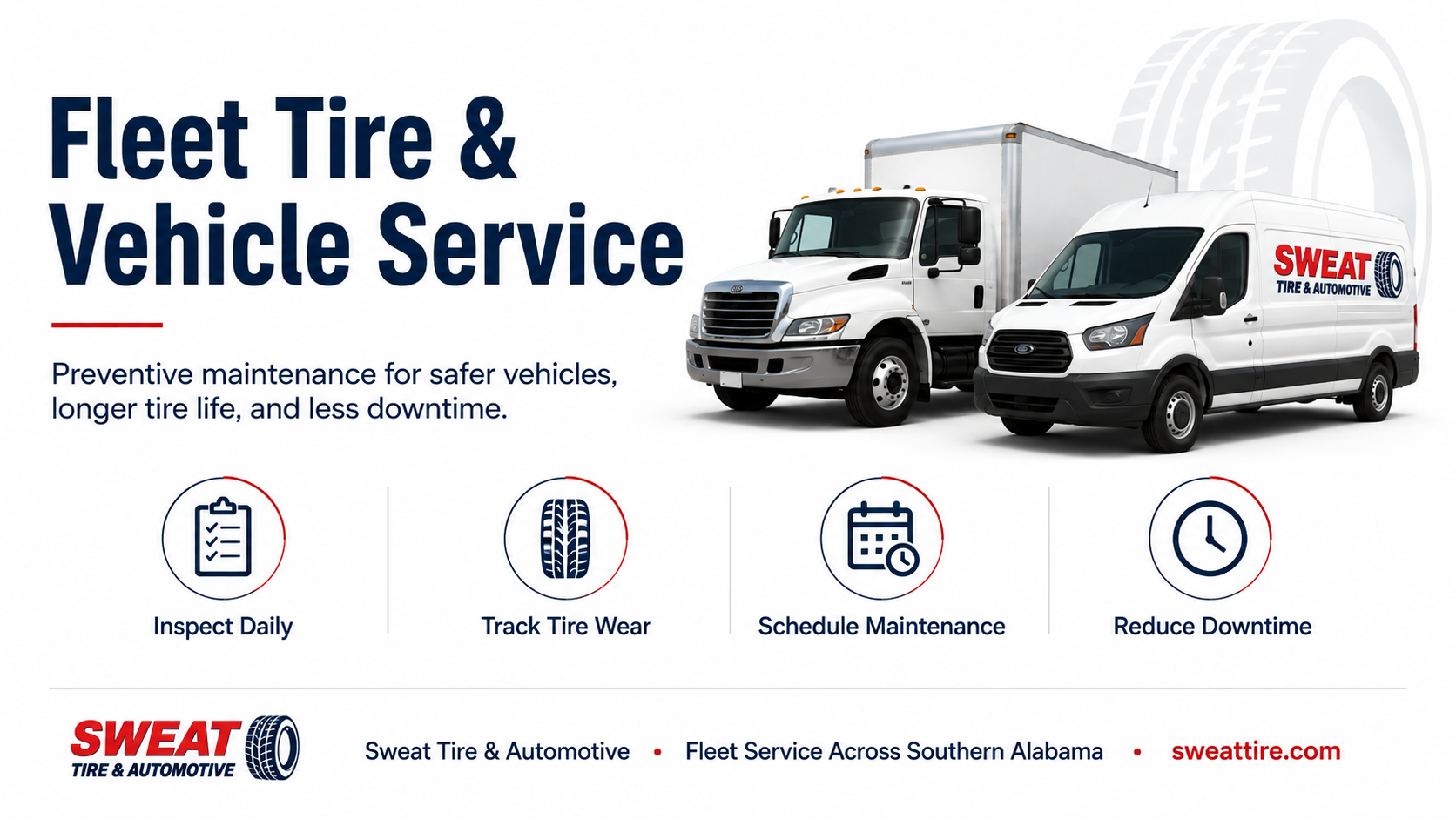
Fleet Tire and Service Management: Best Practices and Recommended Service Intervals
Fleet maintenance is more than responding to dashboard alerts or driver complaints. An effective program creates a consistent system for inspections, preventive maintenance, tire management, repair documentation, and early problem detection.
The goal is to perform the right service at the right time while keeping every vehicle safe, productive, and available. Tire failures, missed oil changes, alignment issues, and weak batteries can lead to costly repairs, delays, towing, and lost revenue.
The strongest fleet programs manage safety, maintenance compliance, tire costs, repair history, downtime, and cost per mile as one connected system.
Sample Fleet Maintenance Interval Chart
The following table is a planning framework, not a replacement for the manufacturer’s schedule. The exact interval should be adjusted for each vehicle’s specifications and duty cycle.
| Inspection or service | Suggested fleet planning interval |
| Driver walkaround and tire inspection | Before each shift or operating day |
| Warning lights, leaks, and visible damage | Before each shift |
| Tire pressure | Daily or weekly for active commercial fleets; at minimum monthly |
| Tire tread measurements | Weekly, monthly, or at every preventive maintenance visit |
| Tire rotation | Commonly every 5,000-8,000 miles when permitted |
| Wheel balance | At tire installation and whenever vibration or irregular wear appears |
| Wheel alignment inspection | At least annually and whenever wear, pulling, impact, or suspension repair occurs |
| Engine oil and filter | Follow oil-life monitor and manufacturer severe-service schedule |
| Brake inspection | At each preventive-maintenance visit; more often for stop-and-go fleets |
| Battery and charging-system test | Every six months and before extreme-weather seasons |
| Fluid, belt, and hose inspection | At every oil or preventive maintenance visit |
| Engine air filter inspection | At every preventive-maintenance visit |
| Cabin air filter inspection | Every 12,000-15,000 miles or according to conditions |
| Cooling-system inspection | At every preventive maintenance visit |
| Transmission and drivetrain fluids | Follow vehicle-specific time, mileage, and severe-service schedule |
| Comprehensive vehicle inspection | At least annually; more often for high-use vehicles |
| FMCSA periodic inspection for covered CMVs | At least every 12 months |
| Maintenance-program review | Quarterly |
| Cost-per-mile and downtime review | Monthly or quarterly |
The National Highway Traffic Safety Administration (NHTSA) recommends checking tire pressure and tread at least monthly, using the vehicle manufacturer’s cold-pressure recommendation rather than the maximum pressure on the sidewall.
It also advises rotating tires every 5,000 to 8,000 miles when the vehicle manufacturer recommends rotation. A commercial fleet may reasonably inspect more frequently because vehicles accumulate mileage faster and remain exposed to greater operational risk.
Create Clear Out-of-Service Standards
Drivers and supervisors should not need to negotiate whether an obviously unsafe vehicle can finish one more route.
Written out-of-service criteria may include:
- Active oil-pressure warning
- Engine overheating
- Severe brake fluid leak
- Brake pedal reaching the floor
- Exposed tire cords
- Tread or sidewall separation
- Flat tire or audible tire leak
- Missing or loose wheel hardware
- Steering component with severe looseness
- Fuel leak
- Significant coolant loss
- Broken windshield obstructing vision
- Inoperative required lights
- Excessive wheel-bearing play
- Serious suspension damage
- Load exceeding tire or vehicle capacity
Federal tire rules prohibit covered vehicles from operating on a tire with exposed body-ply or belt material, tread or sidewall separation, a flat or audible leak, or a cut exposing structural material.
A driver should have the authority to stop using a vehicle when a genuine safety issue exists without being pressured to maintain the day’s schedule.
TPMS Is a Warning System, Not a Maintenance Program
Tire-pressure monitoring systems (TPMS) are helpful, but they should not replace routine gauge checks.
NHTSA notes that TPMS warnings may not activate until a tire is already significantly underinflated. A fleet relying exclusively on the dashboard light may operate tires at below-desired pressure for an extended period.
Record recurring pressure loss. A tire requiring air every week does not merely “need air.” It likely has a puncture, valve leak, bead leak, wheel problem, or another defect.
Track Tread Depth Numerically
“Looks okay” is not a fleet measurement.
Measure tire tread with a proper depth gauge and record the result in 32nds of an inch. Measurements should be taken across the inner, center, and outer tread because one side may wear much faster than the rest.
A tire record might show:
| Position | Inner | Center | Outer |
| Left front | 6/32 | 7/32 | 8/32 |
| Right front | 5/32 | 7/32 | 8/32 |
| Left rear | 8/32 | 8/32 | 8/32 |
| Right rear | 8/32 | 8/32 | 8/32 |
This pattern suggests that the front tires are wearing more heavily on their inner edges. Simply replacing them without inspecting alignment and suspension may cause the replacement tires to develop the same problem.
Understand What Tire Wear Patterns Are Saying
Tire wear is diagnostic information.
Both Shoulders Worn
Possible causes include:
- Chronic underinflation
- Repeated overload
- Aggressive cornering
- Wrong tire for the application
Center Worn
Possible causes include:
- Excessive pressure
- Incorrect pressure strategy for the load
- Tire and wheel mismatch in some applications
One Shoulder Worn
Possible causes include:
- Camber misalignment
- Worn ball joint
- Bent suspension component
- Ride-height problem
Feathered Tread
Possible causes include:
- Incorrect toe
- Worn tie rods
- Steering looseness
- Alignment shift
Cupping or Scalloping
Possible causes include:
- Worn shocks or struts
- Wheel imbalance
- Bent wheel
- Tire runout
- Loose suspension
- Bearing play
Flat Spot
Possible causes include:
- Hard braking
- Vehicle storage
- Brake lockup
- Tire defect
- Out-of-round assembly
A tire should not be replaced in isolation when the wear pattern points to a vehicle problem. The underlying cause should be corrected first.
Sweat tires offer tire inspections, rotation, repair, balancing, and replacement, along with suspension checks and alignment services.
Build Wheel Alignment Into the Tire Program
A vehicle can be misaligned without pulling noticeably.
Toe error may wear tires rapidly while the steering wheel remains nearly centered. Camber may damage the inside shoulder, where a driver rarely looks. A lightly bent suspension part may create a problem only under load.
Schedule an alignment inspection when:
- Tires show uneven or rapid wear.
- The vehicle pulls or wanders.
- The steering wheel is off-center.
- A curb or pothole is struck.
- Suspension or steering parts are replaced.
- The ride height changes.
- New tires are installed after abnormal wear.
- Drivers report unstable handling.
- The vehicle is involved in a collision.
A four-wheel alignment can identify toe, camber, caster, and related geometry that contribute to poor handling and shortened tire life. NHTSA also identifies alignment as an important part of maximizing tire life and preventing the vehicle from veering on a straight road.
For high-mileage urban fleets, an annual alignment check may be too infrequent. Use the fleet’s wear data. If vehicles consistently develop alignment problems every 15,000 miles, schedule inspections before that point.
Establish a Written Tire Repair Policy
Not every puncture is repairable.
A fleet policy should specify that the tire must be removed from the wheel and inspected internally before a permanent repair is approved.
Repairability depends on:
- Puncture location
- Puncture size
- Angle
- Internal damage
- Previous repairs
- Remaining tread
- Whether the tire was driven flat
- Tire category
- Speed rating
- Manufacturer restrictions
A puncture in the central tread area may qualify for repair. Damage in the shoulder or sidewall generally does not.
An external plug alone does not reveal whether the inner liner, cords, or sidewall were damaged while the tire was underinflated. Sweat Tires’ tire service team inspects punctured tires to determine whether repair is appropriate and recommends replacement repair is not a safe option
Every repair should be entered into the tire’s service record. Repeated repairs on one unit may reveal an issue with the route, loading, yard, or driver.
Measure Tire Cost Per Mile
Purchase price alone does not identify the least expensive tire.
A $180 tire lasting 25,000 miles costs 0.72 cents per mile before service and downtime.
A $230 tire lasting 50,000 miles costs 0.46 cents per mile.
Use:
Tire cost per mile = total tire cost ÷ miles in service
The total tire cost can include:
- Purchase
- Installation
- Balancing
- Repairs
- Road-service expense
- Disposal
- Downtime
- Warranty credits
Also, record removal reasons. One tire may deliver strong tread life but experience frequent sidewall damage in the fleet’s actual operating environment. Another may wear faster but produce fewer roadside failures.
The best tire is the one that provides the strongest overall performance for the fleet’s duty cycle, not necessarily the longest mileage warranty or lowest invoice price.
Monitor Steering and Suspension Wear
Fleet vehicles frequently encounter curbs, potholes, construction sites, gravel roads, heavy cargo, and repeated loading cycles.
Inspect:
- Ball joints
- Tie rods
- Control arms
- Bushings
- Shocks and struts
- Springs
- Wheel bearings
- CV joints
- Driveshafts
- Steering rack
- Power-steering system
- Ride height
Suspension wear affects more than ride comfort. It can contribute to:
- Tire cupping
- Alignment changes
- Poor braking stability
- Wandering
- Excessive body motion
- Cargo movement
- Driver fatigue
A vehicle that repeatedly needs alignment may have worn components, allowing the alignment to shift.
Diesel Fleets Need Additional Maintenance Controls
Diesel vehicles may require management of:
- Diesel engine oil
- Fuel filters
- Water separators
- Glow plugs
- Turbocharger systems
- Diesel particulate filters
- DEF and SCR systems
- EGR components
- Charge-air hoses
- Regeneration cycles
Short trips and excessive idling can prevent the exhaust system from reaching operating conditions needed for effective regeneration. Drivers should be trained to recognize regeneration messages, DEF warnings, reduced-power notices, and exhaust-system faults.
Do not repeatedly clear a diesel emissions code to keep the vehicle running. A small sensor, pressure, temperature, or dosing problem can eventually create derating or damage to expensive aftertreatment components.
Track Preventive Maintenance Compliance
A fleet maintenance schedule is not effective unless completion is measured.
Useful compliance categories include:
- Completed early
- Completed on time
- Overdue by mileage
- Overdue by time
- Vehicle unavailable
- Driver failed to report
- Parts delayed
- Appointment missed
- Service deferred by management
Calculate:
PM compliance rate = on-time preventive maintenance services ÷ total preventive maintenance services due
A low compliance rate indicates a management problem, even when the vehicles have not yet experienced many breakdowns.
The breakdowns often arrive later.
Measure Unscheduled Maintenance
Track repairs that occur outside planned service.
Examples include:
- Roadside tire failure
- Dead battery
- Overheating
- Belt failure
- Brake breakdown
- No-start
- Alternator failure
- Transmission fault
- Unplanned warning-light diagnosis
Calculate:
Unscheduled repair ratio = unscheduled repair orders ÷ total repair orders
A rising ratio can indicate:
- Poor inspection quality
- Intervals that are too long
- Driver-reporting problems
- Aging vehicles
- Poor parts selection
- Harsh duty cycle
- Deferred repairs
Not every breakdown is preventable. The goal is to reduce failures that should have been detected earlier.
Build a Relationship With One Fleet Service Provider
Using many repair shops can make maintenance records fragmented and diagnosis repetitive.
A consistent fleet-service relationship allows the shop to understand:
- Vehicle history
- Fleet priorities
- Approval limits
- Common tire sizes
- Duty cycles
- Driver concerns
- Billing requirements
- Replacement plans
- Preferred parts
- Scheduling needs
A fleet-service agreement should clarify:
- Who may authorize work
- Price limits
- Inspection frequency
- Communication method
- Billing process
- Parts standards
- Warranty handling
- Priority scheduling
- After-hours procedures
- Vehicle pickup and delivery availability
- Required documentation
Maintain FMCSA Records When Regulations Apply
Motor carriers operating covered commercial vehicles must comply with applicable inspection, maintenance, and recordkeeping requirements.
The Federal Motor Carrier Safety Administration (FMCSA) requires systematic inspection, repair, and maintenance. For vehicles controlled for at least 30 consecutive days, required records generally include vehicle identification, maintenance operations and due dates, and records showing inspection, repair, and maintenance dates and types.
Covered commercial vehicles must also undergo a periodic inspection at least once every 12 months under §396.17. Roadside inspection reports, defect correction, inspector qualifications, and driver reports may create additional obligations depending on the carrier and vehicle type.
Fleet managers should verify requirements based on:
- Vehicle weight
- Interstate or intrastate operation
- Passenger or property carriage
- Hazardous materials
- State law
- Number and type of vehicles
- Business use
A local repair invoice may support the maintenance record, but the motor carrier remains responsible for ensuring its complete compliance program is maintained.
Fleet Tire and Vehicle Service in Baldwin County and Southern Alabama
A successful fleet maintenance program does not wait for breakdowns. It creates a continuous cycle:
- Inspect the vehicle.
- Record its condition.
- Schedule maintenance.
- Correct defects.
- Measure tire and component wear.
- Analyze cost and downtime.
- Adjust the interval when operating data shows that a change is needed.
Tires should be evaluated based on pressure, tread depth, wear pattern, position, load, age, repair history, and cost per mile. Vehicle maintenance should be managed by manufacturer requirements, time, mileage, engine hours, duty cycle, inspection findings, and repair history.
Sweat Tire & Automotive provides fleet service and preventive maintenance for businesses throughout Baldwin County and Southern Alabama. Services include:
- Fleet tire repair, rotation, balancing, and replacement
- Online tire shopping
- Factory-scheduled maintenance
- Oil changes
- Brake inspection and repair
- Wheel alignment
- Vehicle inspections
- Diesel service and repair
- Complete automotive repair
The Sweat Tire & Automotive locations include:
Atmore, AL
122 E Nashville Ave
Atmore, AL 36502
Bay Minette, AL
231 US-31
Bay Minette, AL 36507
Elberta, AL
13320 Main St
Elberta, AL 36530
Fairhope, AL
21973 AL-181
Fairhope, AL 36532
Flomaton, AL
22620 US-31
Flomaton, AL 36441
Foley – Michigan Ave
155 W Michigan Ave
Foley, AL 36535
Foley – County Road 12
21833 County Rd 12 S
Foley, AL 36535
Loxley, AL
29395 Co Rd 49
Loxley, AL 36551
Monroeville, AL
1385 S Alabama Ave
Monroeville, AL 36460
Robertsdale, AL
22594 AL-59
Robertsdale, AL 36567
Across its locations, Sweat Tire & Automotive provides tire service, preventive maintenance, vehicle inspections, brakes, wheel alignments, diagnostics, diesel service, automotive repair, and fleet support for company cars, delivery vehicles, service vans, pickups, commercial trucks, and other work vehicles.