
How Much Is a Diesel Engine Oil Change?
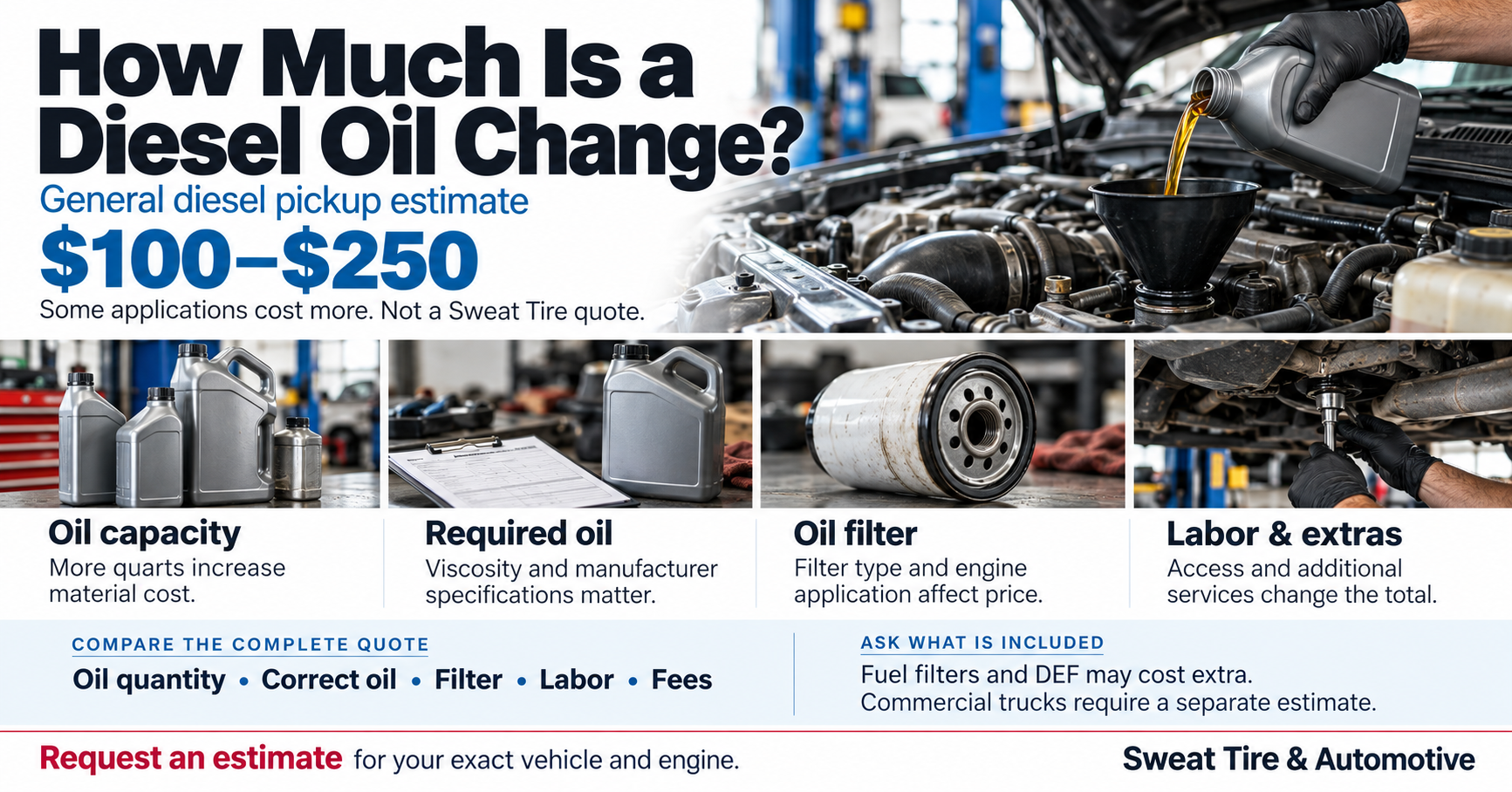
A diesel pickup oil change typically falls in the $100-$250 range, though some applications cost more. The final price depends on the engine’s oil capacity, required oil specification, filter, labor, and included services. A heavy commercial truck requires a separate estimate because its capacity and service needs can differ substantially.
Diesel owners are often surprised when an oil change quote is higher than the price advertised for a gasoline-powered car.
The difference is not simply a “diesel surcharge.”
A diesel engine may require significantly more oil, a different filter, and a lubricant formulated for its combustion and emissions systems. Access and labor can vary, too.
Publicly posted diesel service prices illustrate the variation, with individual providers listing examples around $175-$183 for specific services. Those examples are not a Sweat Tire quote and should not be applied to every diesel vehicle. Source: MAXI Mobile; Source: Bergey’s Buick GMC
The most useful way to compare prices is to understand what your vehicle needs and what each estimate includes.
Why Diesel Oil Changes Often Cost More
Oil capacity is one of the clearest reasons.
A gasoline passenger car may require substantially less oil than a full-size diesel pickup. Larger commercial engines may hold much more again.
Every additional quart affects the material cost.
The oil itself must also meet the engine’s requirements. Diesel lubricants are designed around specific demands, including soot management, wear control, oxidation resistance, and compatibility with emissions equipment.
The filter may differ in size, construction, and price.
Finally, the service may involve underbody panels, tight access, application-specific procedures, or inspections associated with the vehicle’s use.
These factors explain why comparing a diesel pickup quote with a small car coupon often produces an unfair comparison.
What Determines Your Actual Price?
Engine and oil capacity
The exact engine matters more than the badge on the tailgate.
Different engines within the same vehicle family can have different capacities and filter arrangements. Model year changes can also affect requirements.
Provide the year, make, model, and engine when requesting a quote.
A VIN can help the shop accurately identify the application.
Required oil specification
Viscosity is only part of the requirement.
The oil must also meet the appropriate performance category and any manufacturer approval.
Using a cheaper oil that does not meet those requirements is not a sound way to reduce the bill.
Oil filter
A diesel filter must be suitable for the application.
Price can vary due to construction, size, brand, and whether the engine uses a spin-on or cartridge arrangement.
Labor and access
Some filters are easy to reach; others require more access work.
Labor also covers proper draining, sealing, filling, level verification, and leakage checks.
Additional services
A quote may include an inspection, fuel filter replacement, chassis lubrication, or other maintenance.
Those services should be identified separately so you can compare like-for-like estimates.
Diesel Pickup vs. Commercial Truck Service
“Diesel oil change” covers a wide range of vehicles.
A passenger diesel, a heavy-duty pickup, a delivery truck, and a semi-truck are not interchangeable service applications.
They can differ in capacity, filter systems, access, maintenance intervals, and equipment requirements.
Do not assume that a shop offering diesel service can accept every commercial vehicle at every location.
When contacting Sweat Tire for diesel service, describe the vehicle’s size, engine, and intended work.
For a commercial truck, confirm the location’s capabilities and the exact scope of service before bringing the vehicle in.
That avoids misunderstandings about access, scheduling, or equipment.
What Should a Diesel Oil Change Include?
The core service generally involves removing the used engine oil, replacing the appropriate oil filter, and refilling with the required quantity and specification of oil.
The technician should also address the drain plug seal or other sealing components as specified, verify the final level, and check for leaks.
The maintenance reminder should be reset when appropriate.
Additional inspection items vary by service package and vehicle.
Ask whether the appointment includes checks of visible leaks, fluid levels, air filtration, belts, hoses, or other maintenance concerns.
Do not assume a basic oil change includes all diesel maintenance items.
A clear estimate makes that distinction easy to understand.
Are Fuel Filters Included?
Usually, fuel filter replacement is a separate service unless the package specifically includes it.
This distinction matters because diesel fuel filters can add a meaningful amount to the total bill.
Some vehicles have more than one fuel filter or a water separation arrangement. The parts and procedure depend on the application.
An estimate for oil and filter service should not be compared directly with an estimate that also includes fuel system maintenance.
Ask for line items.
The same applies to air filters, transmission service, differential service, coolant replacement, and other work.
Those items may be due, but their timing should be established independently.
Is DEF Part of the Oil Change?
Diesel exhaust fluid (DEF) is part of the emissions system on vehicles equipped to use it.
It does not lubricate the engine and must never be added to the engine oil or fuel tank.
A shop may offer DEF replenishment during a service visit, but that is separate from changing the oil.
Confirm whether it is included and needed.
Also, distinguish a low DEF warning from an engine oil warning. They concern different systems and require different responses.
Your owner’s manual explains the messages for your vehicle.
Conventional, Synthetic Blend, or Full Synthetic Diesel Oil?
The correct choice depends on the engine’s requirements and operating conditions.
Some diesel applications permit several formulations when the required specifications are met. Others require particular products or approvals.
Full synthetic diesel oil may provide useful temperature and oxidation performance, but the marketing category does not override the manufacturer’s instructions.
Do not assume a gasoline engine synthetic oil is appropriate simply because its viscosity matches.
Similarly, do not choose an oil solely because it says “heavy duty.”
The specification must match the application.
The American Petroleum Institute distinguishes diesel oil categories and notes that FA-4 oils are intended for selected applications rather than being universally interchangeable with other diesel oils. Source: API
How Often Does a Diesel Need an Oil Change?
There is no single interval for all diesel engines.
Mileage, calendar time, operating hours, duty cycle, and manufacturer guidance can all matter.
A personal pickup used for highway commuting has a different operating pattern from a work truck that idles for hours or tows daily.
Some commercial applications use maintenance programs that incorporate oil analysis and operating data.
For ordinary ownership, follow the schedule and oil-life system specified for the vehicle.
Do not assume diesel engines can always go longer between oil changes than gasoline engines.
The engine’s size and reputation for durability do not eliminate its lubrication requirements.
Why Idling Matters
Idling creates engine operating time without adding much mileage.
A truck used at job sites can accumulate significant hours while its odometer changes slowly.
Depending on the engine and operation, extended idling can affect contamination, operating temperature, and maintenance requirements.
Record the vehicle’s use accurately.
If the manufacturer provides hour-based guidance or a severe duty schedule, incorporate it into the maintenance plan.
A mileage-only approach may be inadequate for work vehicles.
Sweat Tire’s factory-scheduled maintenance services can help organize maintenance around the vehicle’s actual use.
Towing, Heat, and Workload
A diesel pickup pulling equipment, a boat, or a loaded trailer places additional demand on it.
Oil service should reflect that workload, especially when towing is frequent.
However, towing does not justify inventing a universal shorter interval.
Consult the applicable maintenance schedule and explain your use to the shop.
Also, remember that towing affects systems beyond the engine. Tires, brakes, cooling components, driveline fluids, and trailer equipment deserve attention.
An oil change alone is not a complete towing inspection.
Is Black Diesel Oil a Sign It Needs Changing?
Diesel oil can darken quickly because it holds combustion-related contaminants in suspension.
Dark color alone is not a reliable measure of remaining service life.
It also does not prove that a shop failed to change the oil.
Use the invoice, service date, mileage, and required schedule to track maintenance.
If contamination is suspected due to other symptoms, the oil may need testing, or the engine may need a diagnosis.
A rising oil level, unexplained coolant loss, unusual smoke, or a major change in operation should not be dismissed as normal diesel behavior.
How to Compare Quotes Fairly
Ask each provider the same questions:
- What oil specification and viscosity will be used?
- How many quarts are included?
- Is the correct oil filter included?
- Are additional quantities charged separately?
- Are shop supplies, disposal fees, and taxes included?
- Does the price include fuel filters or other maintenance?
- What inspection is part of the service?
- Is the quote for my exact engine?
A low advertised price may cover a smaller quantity than your engine requires.
A higher quote may include additional work.
Neither price can be judged fairly until the scope is clear.
Can You Save Money by Changing Diesel Oil Yourself?
DIY service can reduce labor costs, but the savings depend on the vehicle and the equipment you already have.
You still need the correct oil, filter, seals, tools, safe access, and a suitable method for collecting and disposing of the used oil.
A large oil capacity makes spill control more demanding.
Mistakes such as overfilling, using the wrong filter, damaging the housing, or leaving a sealing problem can quickly erase the savings.
If you perform your own maintenance, document the date, mileage, products, quantities, and work completed.
Do not extend the interval to make the cost feel more economical.
Why Cheap Oil Can Become Expensive Maintenance
The goal is not to buy the most expensive product.
It is to use the correct product and complete the service properly.
An unsuitable lubricant can compromise protection or compatibility with the engine’s systems. Incorrect filling or filter installation can create immediate problems.
Likewise, skipping needed service to save money may increase the risk of a larger repair.
A good maintenance budget distinguishes routine service from diagnosis and repair.
If you notice a leak, pressure warning, or unusual engine noise, ask for an evaluation rather than treating the next oil change as a guaranteed solution.
Fall Car Care for Diesel Owners
Fall is a useful time to prepare a diesel vehicle for travel, towing, and cooler weather.
Review oil service, fuel filter history, battery performance, coolant requirements, tire condition, brakes, and lighting.
If the truck has been used heavily during the summer, mention that operating history when scheduling.
For work vehicles, also review downtime planning. Completing scheduled service before a busy period can be easier than arranging it after a warning or breakdown.
The Car Concepts fall car care checklist provides a broader framework.
Sweat Tire’s automotive repair services can help address related maintenance needs alongside diesel service.
Frequently Asked Questions
Why is my diesel oil change more expensive than my gasoline car’s?
Common reasons include greater oil capacity, different oil requirements, filter cost, and labor. Compare the actual service specifications.
Does a diesel oil change include fuel filters?
Only if the package says so. Ask for a separate explanation of fuel filter service and its required interval.
Can I use a coupon advertised for a regular oil change?
Eligibility depends on the offer and vehicle. Ask whether the oil quantity, filter, and diesel specification are covered.
Does full synthetic let me ignore engine hours?
No. Engine hours and duty cycle can remain relevant even with synthetic oil.
Can Sweat Tire service a semi-truck?
Confirm the exact vehicle and service requirements with the location before booking. Diesel service availability does not automatically establish capability for every commercial application.
Request a Diesel Oil Change Estimate
A useful quote begins with your vehicle’s exact engine and service needs.
Contact Sweat Tire & Automotive with your vehicle information, mileage, towing habits, and any symptoms.
Ask for an estimate that clearly separates oil and filter service from fuel filters, inspections, and additional maintenance. That makes the price easier to understand and the service easier to plan.