
Tire Balancing and Road Force Balancing in Baldwin County and Southern Alabama
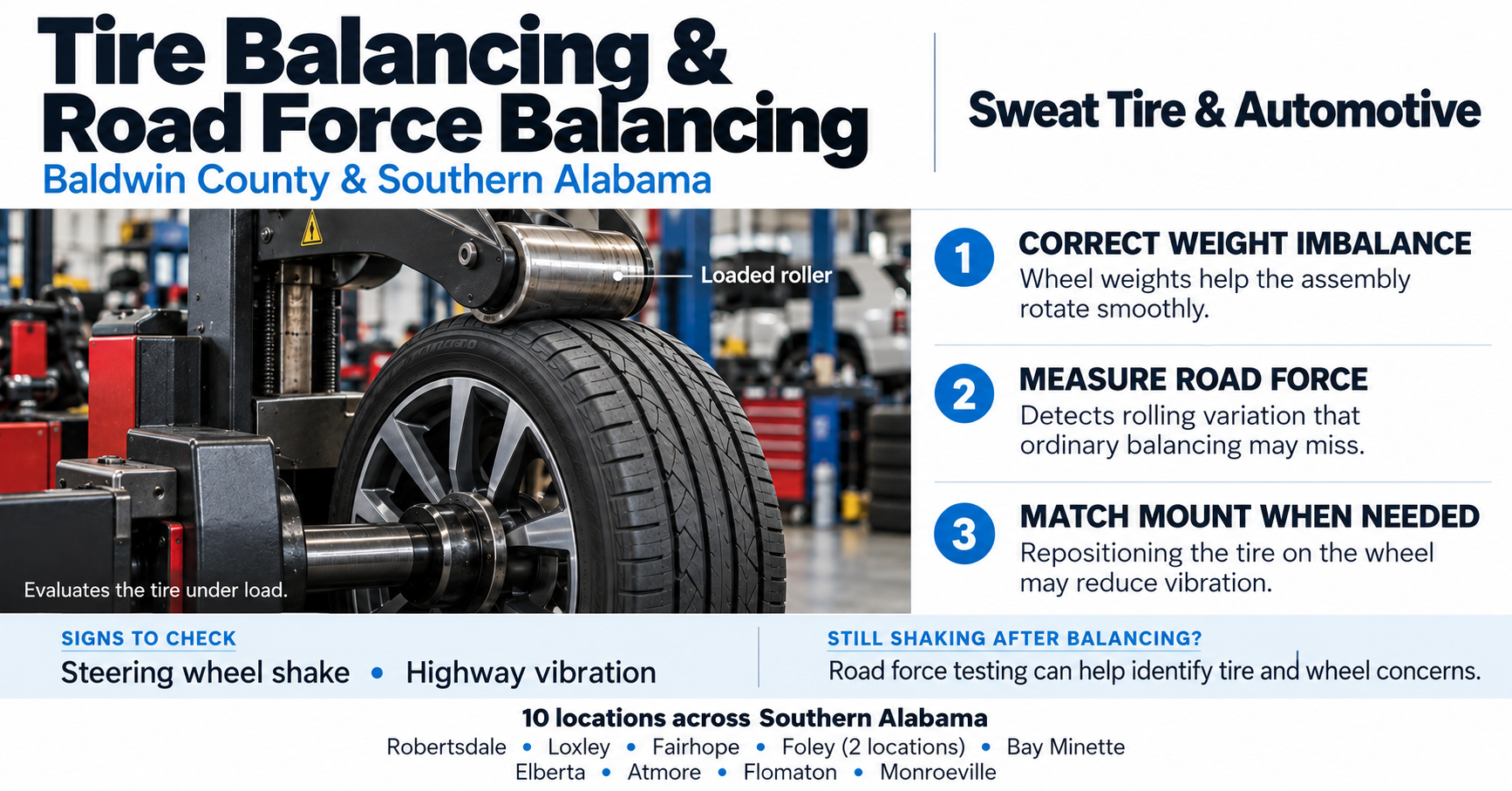
Sweat Tire & Automotive offers tire balancing and road force balancing to help diagnose and correct tire-related vibration. Conventional balancing corrects uneven weight distribution, while road force testing evaluates how the tire and wheel behave under load. Together, these services help address steering wheel shake, highway vibration, and a rough ride that persists after ordinary balancing.
We serve drivers throughout Baldwin County and Southern Alabama, with locations in Robertsdale, Loxley, Fairhope, Foley, Bay Minette, Elberta, Atmore, Flomaton, and Monroeville.
Whether you drive a family SUV, a daily commuter, or a pickup that carries tools and equipment, a change in ride quality deserves attention. Our team can help determine whether the problem involves balance, tire uniformity, wheel condition, or another component.
What Tire Balancing Corrects
A mounted tire and wheel can have uneven weight distribution even when both components look normal. As the assembly rotates, that imbalance creates forces that may produce shaking through the steering wheel, seat, or floor.
Computerized balancing equipment measures the imbalance and identifies where corrective weights should be placed. Proper weight placement helps the assembly rotate more smoothly and reduces vibration associated with uneven mass distribution.
New tires should be balanced after mounting. Existing assemblies may also need a balance check if a weight is lost, a tire is removed and remounted, or vibration develops.
Correct mounting and centering on the balancing machine are essential. If the assembly is not centered accurately, the readings may not reflect how it rotates on the vehicle.
Road Force Balancing for Vibration That Will Not Go Away
A tire can be correctly balanced by weight and still cause vibration. This happens because weight distribution is only one factor affecting how smoothly a tire rolls.
Tires flex as they support the vehicle. Small differences in stiffness around a tire’s circumference can cause it to exert varying forces as it rotates. Tire and wheel shape also influence how the complete assembly behaves under load.
Sweat Tire’s road force balancing service adds a loaded-roller test to the balancing process. A roller presses against the rotating tire’s tread, allowing the equipment to measure variations that ordinary weight balancing may not reveal.
These measurements help investigate radial force variation—changes in the force generated as the tire rolls under load. This is particularly useful when previous balancing has improved the ride only slightly or has not resolved the complaint.
How Match Mounting Can Improve the Results
Road force testing can help determine whether repositioning the tire on its wheel would reduce vibration. This adjustment is called match mounting.
The tire and wheel each contribute to the assembly’s rolling characteristics. Changing their position relative to one another can allow those characteristics to offset each other more effectively. For example, the equipment may identify an opportunity to align a tire’s measured stiff spot with an appropriate low point on the wheel.
When indicated, the tire is repositioned, the assembly is balanced, and the results are checked again.
Match mounting keeps the tire on the same wheel. It is different from tire rotation, which moves complete assemblies between positions on the vehicle. It can improve a suitable combination, but it cannot restore a damaged tire or straighten a bent wheel.
What Our Balancing and Road Force Evaluation Involves
The appropriate service depends on your symptoms and the condition of the assemblies. The process considers several important details:
- Your description of the vibration. We review where you feel it, when it occurs, and whether it began after tire service or a road impact.
- Tire and wheel condition. Inflation, tread wear, visible damage, and existing wheel weights help establish what needs attention.
- Weight-balance measurements. The assembly is properly mounted and measured to determine the necessary weight correction.
- Loaded-roller testing. During road force service, the equipment evaluates rolling variation with the tire under pressure from the roller.
- Correction and rechecking. Weight adjustments or match mounting may be appropriate. Further inspection or replacement may be recommended when the findings indicate another concern.
Tell us about previous balancing, wheel repairs, aftermarket wheels, or a recent tire-size change. Those details help us evaluate the assembly and understand what has already been attempted.
Signs Your Tires and Wheels Need Attention
Schedule an inspection if you notice:
- Steering wheel shake while maintaining a steady road speed.
- Vibration through the seat or floor, especially on otherwise smooth pavement.
- A rough ride after installing new tires or having a tire repaired.
- A vibration that changes after rotation.
- Persistent shaking after conventional balancing.
- A new symptom following a pothole or curb impact.
The timing helps narrow the investigation. Vibration mainly during braking may involve the brakes, while shaking under acceleration may require checks beyond the tires and wheels.
You do not need to identify the cause before making an appointment. Describe what you feel and the conditions that make it better or worse.
Tire Service for Daily Drivers and Working Vehicles
A pickup carrying equipment, a family vehicle taking longer trips, and a car used for short daily drives can have different maintenance needs.
When scheduling, explain how your vehicle is used. Mention frequent towing, heavy loads, larger tires, or aftermarket wheels. If the vibration changes when the vehicle is loaded, that information can help guide the inspection.
Balancing and road force testing do not compensate for overloading, incorrect inflation, or tires that are unsuitable for the application. Those concerns need to be addressed as part of maintaining the vehicle.
For commercial trucks or specialized equipment, provide the tire size and vehicle details before arriving so the location can confirm the appropriate equipment and service arrangements.
Balancing, Road Force Testing, Rotation, and Alignment
These services address different concerns:
| Service | What it does |
|---|---|
| Tire balancing | Corrects uneven weight distribution in the mounted tire and wheel. |
| Road force testing | Measures variation in how the assembly rolls under load. |
| Tire rotation | Changes tire positions to help manage differences in wear. |
| Wheel alignment | Adjusts wheel angles that affect tracking and tread contact. |
A vehicle with vibration, pulling, and uneven wear may need more than one service. A wheel alignment inspection can help address alignment concerns, while steering or suspension problems may require repair before tire service can deliver the expected result.
Our broader tire repair and maintenance services can help address related issues during your visit.
Tire Balancing and Road Force Questions
How often should tires be balanced?
Follow the vehicle and tire manufacturer’s recommendations, and have new or worsening vibration checked. New tire installation and tire removal or remounting are important opportunities to address balance. Road force testing is especially useful for unresolved vibration rather than something every vehicle automatically needs at each rotation.
Can new tires need road force balancing?
Yes. New tires still have variations in their construction, and the way they interact with the wheels can affect ride quality. Road force testing can help investigate a vibration that appears after installation.
Why did the vibration change after tire rotation?
Moving an assembly to another position can make an existing imbalance or rolling concern more noticeable. Tell us how the symptom changed and whether you now feel it through the steering wheel, seat, or floor.
Will road force balancing fix every vibration?
No. It helps evaluate tire and wheel concerns, but vibration can also originate in the brakes, steering, suspension, or drivetrain. The findings help determine whether another system needs inspection.
Can balancing make a damaged tire usable again?
No. Balancing cannot repair a sidewall bulge, restore worn tread, or correct structural damage. A damaged or excessively worn tire needs its own evaluation.
Schedule Tire Balancing or Road Force Balancing Near You
If your vehicle shakes at highway speed or still vibrates after previous balancing, Sweat Tire & Automotive can help investigate the cause.
Contact your local shop for tire balancing and road force balancing in Baldwin County and Southern Alabama. Tell us your vehicle information, when the vibration occurs, and any recent tire or wheel work so we can plan the appropriate service.
Find Your Nearest Sweat Tire Location and Schedule Service
Sweat Tire has 10 southern Alabama locations:
- Atmore, AL
- Bay Minette, AL
- Elberta, AL
- Fairhope, AL
- Flomaton, AL
- Foley, AL — Michigan Avenue
- Foley, AL — County Road
- Loxley, AL
- Monroeville, AL
- Robertsdale, AL